
In the ever-evolving landscape of digital marketing, we are currently witnessing what industry experts call the “third wave” of digital advertising. The first wave was led by search engines, primarily Google; the second was defined by the social media explosion of Meta and its peers. Now, in 2026, the spotlight has firmly shifted toward Retail Media Networks (RMNs). For brands and retailers alike, these networks are no longer just a peripheral strategy—they have become the central nervous system of modern commerce.
As the digital ecosystem moves further away from third-party cookies and grapples with increasing privacy regulations, the value of a direct relationship with the consumer has never been higher. Retail Media Networks represent the bridge between those relationships and actionable marketing. By the end of this year, it is estimated that nearly one in every four digital advertising dollars will be spent within these networks, signaling a fundamental shift in how brands reach their customers.
What is a Retail Media Network?
At its core, a Retail Media Networks is an advertising platform set up by a retailer that allows third-party brands to purchase advertising space across the retailer’s digital and physical properties. This includes a wide array of touchpoints: sponsored search results on a website, display banners in a mobile app, targeted emails, and even digital signage within brick-and-mortar stores.
What makes an Retail Media Networks fundamentally different from a traditional ad network is the data that powers it. While a social media platform might know what you “like” and a search engine knows what you are “looking for,” a retailer knows what you actually “buy.” This distinction is the bedrock of the Retail Media Networks ‘s value proposition. It leverages first-party transaction data to show ads to consumers at the exact moment they are in a “shopping mindset,” often just seconds away from a purchase decision.
The Mechanics of the Modern Retail Media
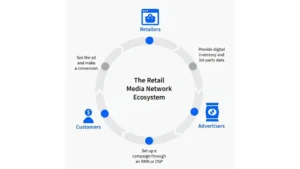
The operation of a Retail Media Networks involves a sophisticated interplay between three key participants: the retailer, the advertiser, and the technology partner.
The retailer acts as the host. They provide the “real estate”—the high-traffic digital environments like websites and apps—and the “fuel,” which is the first-party data. This data includes everything from historical purchase behaviour and loyalty program status to real-time search queries and cart additions.
The advertiser (usually a Consumer Packaged Goods brand or a supplier) uses the network to gain visibility. In an increasingly crowded marketplace, organic search results on a retail site are often buried. By using the Retail Media Networks, a brand can ensure its new granola bar is the first thing a customer sees when they search for “healthy snacks” on a grocery app.
The technology partner provides the infrastructure that connects the two. These platforms manage the bidding auctions, serve the creative assets, and, perhaps most importantly, provide the measurement tools. In 2026, these tech stacks have become highly automated, often utilizing artificial intelligence to optimize bids and placements in real-time based on the likelihood of conversion.
Why the Explosion in Growth in Retail Media Network?
Several factors have converged to make Retail Media Networks the fastest-growing sector in digital advertising.
The first is the death of the third-party cookie. For years, digital marketing relied on tracking users across the web to build profiles. As privacy regulations like GDPR and CCPA matured, and as browsers phased out cookies, brands lost their “eyes.” Retail Media Networks offered a “walled garden” solution. Because the data is owned by the retailer and collected directly from their own customers (first-party data), it is privacy-compliant and incredibly accurate.
The second factor is the “Close-the-Loop” measurement. In traditional advertising, it is notoriously difficult to prove that a specific digital ad led to a specific sale, especially an offline one. Retail Media Networks solve this by linking the ad impression directly to the transaction. If a customer sees a sponsored ad for a detergent on the Walmart app and then buys that detergent using their loyalty card in a physical store two days later, the Retail Media Networks can attribute that sale. This level of “deterministic” attribution is the holy grail for marketers who need to justify every cent of their budget.
Thirdly, for retailers, Retail Media Networks are a high-margin revenue stream. Traditional retail is a limited profitability business, often functioning on 2% to 4% net margins. Advertising, however, can boast margins of 70% or higher. For giant retailers, this “found money” allows them to keep product prices competitive while investing in better technology and customer experiences.
The Benefits for All Stakeholders in Retail Media Marketing

The beauty of a well-executed Retail Media Networks is that it creates a “triple win” scenario.
For Brands, the primary benefit is relevance. Instead of shouting into the void of the open web, they can speak to a customer who is already in the aisle. This leads to remarkably higher return on ad spend. Furthermore, brands gain access to deep insights. They can see not just how many people bought their product, but who they are—are they new to the brand, or are they loyalists who would have bought it anyway? This distinction, known as incrementality, is a major focus for marketers in 2026.
For Retailers, beyond the obvious revenue growth, Retail Media Networks strengthen their relationships with suppliers. It turns the retailer from a mere distribution point into a strategic marketing partner. Additionally, the data gathered through the ad network can inform merchandising decisions. If a retailer sees a massive surge in searches for “plant-based jerky” that isn’t being met by current inventory, they can pivot their procurement strategy.
For Shoppers, believe it or not, there is a benefit too. When done correctly, retail media improves the shopping experience by making it more personalized. Instead of seeing irrelevant ads for products they never buy, shoppers are presented with deals on items they actually need or discover new products that align with their preferences. It reduces the “friction” of discovery in a digital store that might contain millions of items.
The Challenges of a Fragmented Landscape in Retail Media Marketing

Despite the meteoric rise, the Retail Media Networks space is not without its “growing pains.” As we move through 2026, the biggest challenge facing advertisers is fragmentation.
Almost every major retailer now has its own network. Amazon, Walmart, Target, and Kroger were the pioneers, but now even niche retailers like Home Depot, Wayfair, and even beauty brands like Sephora have launched their own. For a brand manager at a large company, this means managing many different platforms, each with its own interface, its own data standards, and its own way of reporting success.
This fragmentation leads to “siloed data.” It is difficult to get a holistic view of how a brand is performing across the entire retail landscape when one network reports total sales and another network reports gross merchandise value, this has caused a new category of aggregator tools—software that is mounted on all these networks to give a single dashboard for advertisers.
There is also the risk of “ad fatigue” and a degraded user experience. If a retailer becomes too aggressive in monetizing their site, the search results can become cluttered with “sponsored” content, making it harder for customers to find what they actually want. Maintaining the balance between ad revenue and a clean shopping interface is a tightrope every retailer must walk.
Future Trends: What’s Next for 2026 and Beyond?

As we look toward the future, several trends are poised to redefine Retail Media Networks once again.
- Omnichannel Integration: The gap between “online” and “offline” is vanishing. We are seeing more “in-store retail media,” where digital screens at the end of aisles or on “smart carts” show ads based on where the customer is standing in the store. Using geolocation and loyalty data, a retailer can send a push notification with a coupon for soda just as the customer enters the beverage aisle.
- The Move to the “Upper Funnel”: Historically, retail media was seen as a “bottom of the funnel” tool—meant for converting someone who is already shopping. Now, Retail Media Networks are moving into brand building. Through partnerships with Connected TV (CTV) and social media, retailers are using their data to target ads on Netflix or Disney+. Imagine seeing a commercial for a specific beauty brand on your TV because the retailer knows you recently bought a complementary skincare product.
- Artificial Intelligence and Agentic Commerce: With the rise of AI agents that can “shop” for consumers, Retail Media Networks are adapting. Instead of just showing a banner to a human, the network must now provide structured data to an AI agent that might be comparing the nutritional value and price of ten different brands of oat milk simultaneously.
- Standardization: Under pressure from frustrated advertisers, the industry is moving toward standardized metrics. Organizations like the IAB (Interactive Advertising Bureau) are working to ensure that a “click” or an “impression” means the same thing across every network, allowing for easier cross-platform comparison.
Conclusion: Embracing the Data-Driven Future

Retail Media Networks have fundamentally changed the “physics” of digital marketing. They have shifted the power dynamic from platforms that host content to platforms that host commerce. For brands, the message is clear: if you are not visible where the transaction happens, you are essentially invisible.
Success in this new era requires more than just a large ad budget. It requires a deep understanding of retail data, a willingness to experiment across fragmented platforms, and a relentless focus on the customer experience. As we progress through 2026, the brands that win will be those that stop viewing retail media as just another line item in their marketing budget and start viewing it as the most powerful tool in their arsenal for building lasting, data-driven relationships with their customers.
The third wave is here, and it is reshaping the world of retail one click at a time.
Author : Anand Vazhappara