
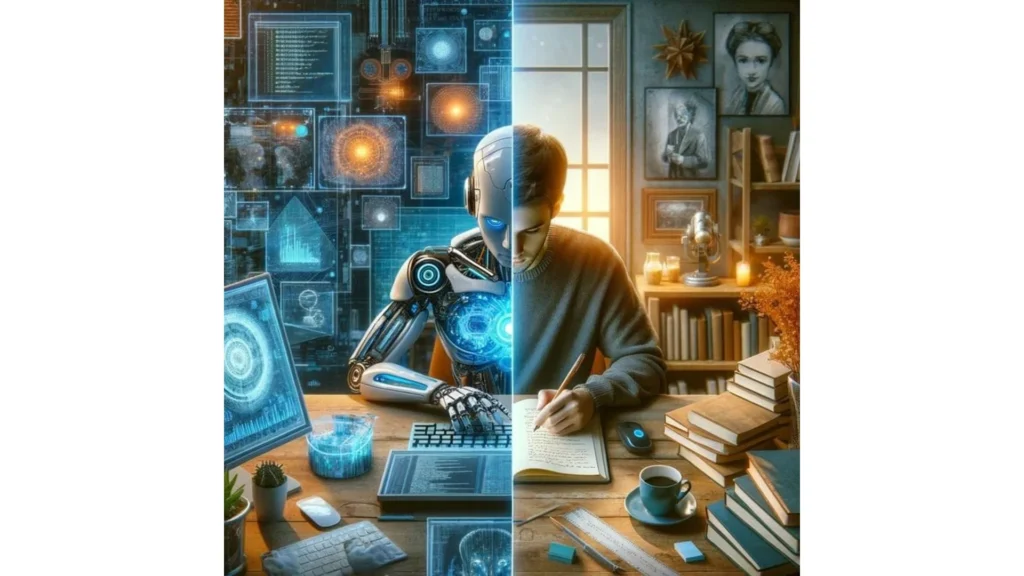
In the early 2020s, the digital marketing world was gripped by a binary panic. On one side stood the traditionalists, clutching their Moleskine notebooks and arguing that the “soul” of a brand could never be replicated by a machine. On the other side were the technocrats, claiming that human copywriters and designers were legacy costs soon to be automated into extinction.
We’ve discovered that AI didn’t replace creativity; it industrialized it. But in doing so, it also raised the value of the “human spark” to an all-time high.
This blog explores the tension, the triumphs, and the ultimate synergy between silicon and soul in the modern marketing landscape.
1. The Current Landscape: Where AI Dominates
To understand the “versus” in human creativity vs artificial intelligence, we must first acknowledge where the machine has definitively won. In 2026, certain creative tasks are no longer seen as “creative” at all—they are seen as data-processing tasks.
A. Hyper-Personalization at Scale
Before the AI revolution, a “personalized” email meant putting the recipient’s name in the subject line. Today, AI generates thousands of unique versions of a single ad campaign.
The AI Role: It analyzes a user’s real-time intent, past purchase history, and even current local weather to generate a specific visual and headline.
The Result: A human cannot write 10,000 versions of a Facebook ad in an afternoon; an AI can do it in seconds.
B. Iterative Testing (A/B Testing on Steroids)
We used to wait weeks to see which headline performed better. Now, AI-driven platforms perform “Multivariate Creative Optimization.” They swap out colors, fonts, and CTA placements in real-time, evolving the creative based on live performance data.
C. Content Foundational Work
AI has taken over the “drudge work” of creativity. This includes:
Generating SEO meta descriptions.
Resizing assets for 50 different social platforms.
Transcribing and summarizing video content into blog posts.
Initial keyword clustering and topic ideation.
2. The Wall: Where AI Hits a Creative Ceiling

Despite its ability to process petabytes of data, AI in 2026 still struggles with the very things that make marketing memorable. Large Language Models (LLMs) and Image Generators are essentially “averaging machines.” They predict the most likely next pixel or word based on everything that has already been created.
This leads to the “Sea of Sameness.”
A. The Lack of True Originality
AI cannot create “new” concepts; it can only recombine existing ones. If you ask an AI to design a “futuristic car,” it will give you a sleek, silver vehicle because that’s what 99% of futuristic car images look like. A human creator might decide that the future of cars isn’t silver or sleek—it might be organic, moss-covered, or invisible.
B. Cultural Nuance and Subtext
Marketing often relies on “reading the room.” A joke that works in London might fall flat in Mumbai. A trending meme can become “cringe” in a matter of hours. AI struggles with the subtext of human culture—the “inside jokes” and the subtle emotional shifts that drive viral movements.
C. The “Empathy Gap”
AI can simulate empathy, but it doesn’t feel it. Great marketing is often born from a place of deep human frustration or desire. Think of the most iconic campaigns (Nike’s “Just Do It” or Apple’s “Think Different”). These weren’t built on data points; they were built on a profound understanding of the human condition.
3. The Human Advantage: The “X-Factor” in 2026

In 2026, the most successful marketers are those who lean into the traits that machines cannot replicate. We call these the Three Pillars of Human Creativity:
I. Strategic Intuition
AI is excellent at answering “How?” but terrible at answering “Why?”
A human strategist can look at a declining sales report and realize that the problem isn’t the ad copy, but a fundamental shift in how people perceive the brand’s ethics. Humans can make “gut” decisions that defy the current data but lead to long-term breakthroughs.
II. Moral and Ethical Curation
As AI generates more content, the risk of “hallucinations” or offensive output increases. Humans serve as the Chief Ethical Officers of creativity. They ensure the brand voice remains authentic and doesn’t accidentally alienate its audience through a poorly “hallucinated” AI fact.
III. The Art of Storytelling
Storytelling is more than just a sequence of events. It’s about pacing, tension, and the “unspoken.” A human writer knows when to break the rules of grammar for emotional effect. An AI, programmed to be “correct,” often irons out the very imperfections that make a story feel real.
4. The New Workflow: The “Centaur” Marketer
The term “Centaur” comes from the world of chess, referring to a human-AI team that is stronger than either alone. In digital marketing, this is the gold standard for 2026.
The Creative Process 2.0:
Phase 1: Research (AI-Led): AI scrapes the web to identify what competitors are doing, what the audience is searching for, and what the current sentiment is.
Phase 2: Ideation (Human-Led): The human marketer takes those insights and identifies a “hook” or a “contrarian” angle that the data didn’t explicitly suggest.
Phase 3: Production (AI-Assisted): The human uses Generative AI to create 50 different versions of that hook, generating images, video clips, and copy drafts.
Phase 4: Refinement (Human-Led): The human acts as the Editor-in-Chief, “humanizing” the AI output, adding personal anecdotes, and ensuring the brand’s unique voice shines through.
5. Case Study: The 2025 “Ghost Brand” Experiment
Last year, a major beverage company ran an experiment. They created two campaigns for a new energy drink:
Campaign A: Entirely AI-generated. The AI chose the name, the colors, the target audience, and wrote all the ads based on “high-conversion” historical data.
Campaign B: Human-AI Hybrid. AI handled the data and scaling, but a human creative team developed a quirky, slightly “weird” brand personality that leaned into self-deprecating humor.
The Result? Campaign A had a high initial click-through rate (it was “optimized” to be clicked), but Campaign B had a 400% higher brand recall and a much higher long-term customer loyalty. People clicked on Campaign A because it looked familiar; they remembered Campaign B because it felt human.
6.Practical Tips for Marketers in an AI World

If you want to stay relevant as a creative professional, you need to change your toolkit.
Step 1: Master Prompt Engineering
Think of AI as a very talented, very literal intern. If you give a vague prompt (“Write a blog about shoes”), you get a boring result. If you give a “Creative Brief” prompt (“Write a 500-word blog about the psychological comfort of old sneakers, using a nostalgic tone and referencing 90s street culture”), you get magic.
Step 2: Focus on “Deep Content”
The internet is currently being flooded with “shallow content” (AI-generated listicles and generic tips). To stand out, humans must produce Deep Content:
First-person case studies.
Opinion pieces with a strong, potentially controversial stance.
Interviews with other humans.
Behind-the-scenes looks at real business struggles.
Step 3: Learn to Edit, Not Just Write
Your value is no longer in “putting words on a page.” Your value is in curation. Can you take a 2,000-word AI draft and find the three sentences that are actually brilliant? Can you spot the “AI-isms” (words like delve, testament, or landscape) that signal to the reader that a human wasn’t involved?
7. The Ethical Conflict: The Copyright and Authenticity Crisis

We cannot talk about human creativity vs artificial intelligence without addressing the elephant in the room: Who owns the creative?
In 2026, the legal landscape is still shifting.
Copyright: In many jurisdictions, purely AI-generated work cannot be copyrighted. This means a competitor could technically “steal” your AI-generated ad, and you’d have no legal recourse.
The “AI Disclosure” Label: Platforms like Instagram and TikTok now automatically flag content that is significantly AI-altered. For brands, this creates a dilemma: Do you want your audience to see a “Made with AI” tag on your heartfelt holiday campaign?
This is why “Human-in-the-loop” is not just a creative choice—it’s a business necessity. By ensuring a human is the primary driver of the creative, you protect your intellectual property and maintain your brand’s integrity.
8. Conclusion: The Victory of the “Augmented Creator”
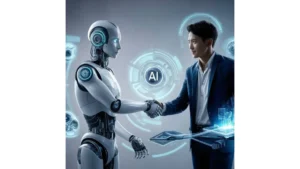
So, who wins the battle of human creativity vs artificial intelligence?
Neither. The winner is the marketer who refuses to choose.
AI has democratized the ability to create, but it has made the quality of the idea more important than ever. In a world where everyone can generate a professional-looking image in five seconds, the person who knows what to generate—and why—is the person who wins.
As we move further into 2026, don’t fear the machine. Use it to automate your boredom so you can spend your time on what truly matters: connecting with other humans.
Digital marketing has always been about the bridge between a product and a person. AI is just the most powerful tool we’ve ever had to build that bridge.
Author : Anand Vazhappara